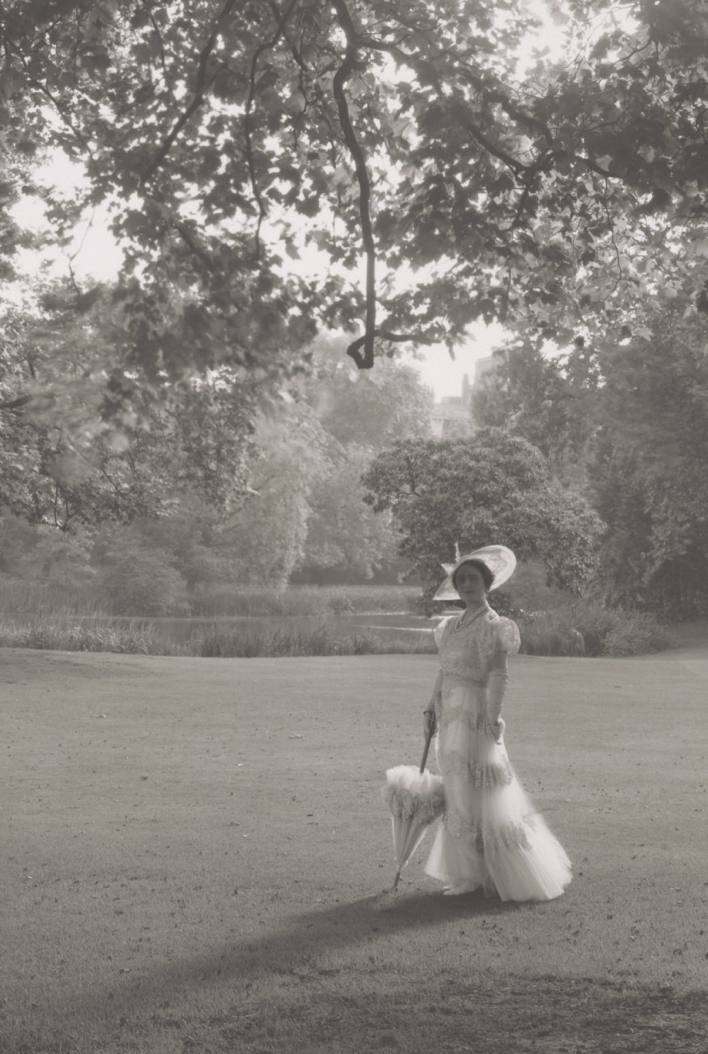
HM Queen Elizabeth, 1939
Cecil Beaton
A short story by SJ Bennett …
THE MOST DANGEROUS WOMAN IN EUROPE
May 1938
In his office at the Chancellery in Berlin, heavy curtains blocked out the sun while the Führer watched a projected film of spliced-together newsreels from the previous day.
First came the Americans. A quick viewing of Pathé and Paramount reassured him that they continued to be mostly self-involved. Let them worry about the stock market and the price of corn while he occupied himself with the next thousand years of the Reich.
Next, the new British king had made a speech. Hitler watched the man stammer and stutter, pausing for an eternity between his words. This George VI, as he had styled himself, was a very unprepossessing individual, unlike his older brother, Edward VIII, who was blonder, more square-jawed and Aryan-looking, and more interesting in every way. However, despite all this, Edward was no longer king – and by his own, unfathomable choice. Hitler was disgusted by the recent abdication. What sort of man did that, when he had a country to lead?
On a more personal note, the Führer missed Edward and Wallis, the woman for whom Edward had abandoned the throne. They appreciated the work that the National Socialist party was doing for the common man. They had visited Berlin and shown real fascination and friendship – useful when it came to cutting out the French. Whereas George, the weedy younger brother, listened to his small-minded politicians, who had no love for the Third Reich.
As his speech on the newsreel showed, George lacked the most basic oratory skills. The Fürher’s own prowess in that department was a foundation of his success. He pitied the frumpy, Scottish wife who stood at the king’s side – how Wallis had laughed about her on her last visit. She said the woman looked like a dumpy little cook!
The newsreel ended on the observation that the British king and queen would be making a trip to Paris soon. Hitler was obsessed with Paris. Though he had never visited, he knew every landmark and fancied himself one day walking among the locals on its streets and boulevards. They were chic, those Parisian women. They would eat the Scottish cook alive. The thought amused him. It would be nice to hear Wallis’s review of the events one day.
In his own office in the War Office in Whitehall, Jonathan Trader, too, was thinking about the royal visit. With three weeks to go, a vast amount of effort had been put into planning it, but Jonathan wasn’t convinced of its success. One year after the unexpected coronation, the king and his consort, Queen Elizabeth, remained popular at home, but were untested abroad. The new king was shy and could be prickly. Would the French warm to him? As a dutiful civil servant Jonathan liked to hope so, but there was too much at stake for mere hope to be enough.
Jonathan’s superior, Sir Elliot Graham, appeared at his office door. Pinstriped and immaculate, Sir Elliot was a seasoned ministry man who had risen to the role of Permanent Under Secretary. He was hard to please and harder still to shock. Today, though, he looked rattled.
‘Have you heard the news?’
Jonathan frowned. ‘No, what?’
‘The Countess of Strathmore’s dead.’
There was a lot going on in the world, and among the various potential catastrophes, the demise of a minor British aristocrat was very much not what Jonathan had been expecting to hear.
‘I take it we need to care?’
‘Care? Of course we do!’
‘Did you know her?’ Jonathan asked. Were the countess and Sir Elliot related, perhaps? It wouldn’t surprise him. The name rang a bell.
‘Not personally, no, of course not.’ Sir Elliot plonked himself heavily in the chair opposite Jonathan’s desk. ‘She lived in Scotland most of the time. They keep a house in Mayfair, not far from my mother, bur that’s hardly the point. You do know who she is?’
‘Remind me.’
Sir Elliot stared at him despairingly. Jonathan, polite, phlegmatic, with the face and manner of a Romantic poet, exasperated half the battle-hardened men in the Department for Extraordinary Affairs. He was a keen brain, with a Double First in Classics from Oxford, but he had a remarkable blind spot for the obvious. He would have been sidelined very early, if he hadn’t turned out to be a rather brilliant and unconventional strategist. They tolerated him, and occasionally thanked their lucky stars for him. With everything that was happening in Berlin and beyond, it was felt he might be a secret weapon they would soon be very grateful to have.
‘The Countess of Strathmore,’ Sir Elliot said slowly, ‘is the queen’s mother. She’s been on her deathbed for weeks. It’s in all the papers. Her Majesty will be in bits. They were a very close family.’
‘Ah. Oh. I remember now.’
Jonathan could vaguely picture her. Tall lady. Liked gardening. Lived in Macbeth’s castle, Glamis, said to be the most haunted in Scotland. She had worn a coronet at the coronation last year, standing with the young princesses. She seemed perfectly well at the time, and not unduly ancient. Poor woman, but why …? He suddenly realised the problem.
‘Paris!’
‘Yes, Paris,’ Sir Elliot agreed, thumping Jonathan’s desk to emphasise the point.
‘The queen will be in mourning!’
‘Exactly.’ Sir Elliot slumped back in his chair.
‘Will she go?’
Sir Elliot threw up his hands. ‘She must. The Palace hasn’t made a comment yet.’ He was quiet for a moment, wrestling with some deep emotion. It released itself in one quiet word. ‘Bugger! What we needed was sparkle. There’ll be none of that.’
Jonathan stood up and gazed at the busy thoroughfare of Whitehall through his office window, deep in thought.
He was fond of the new queen. She was smiling, unassuming, with none of the complicated airs and graces of the Simpson woman. Normally, there was a sort of cheerful magic about her, and they’d been relying on that in Paris, what with the king being so … Well charming wasn’t the word, and the French so in need of being charmed right now.
‘She’ll do her best,’ he murmured. ‘If she goes.’
Behind him, Sir Elliot harrumphed. ‘Think about it, Jonathan. If she does go, she’ll be dressed in black. She’s five-foot two. She can be radiant when she smiles, but she won’t be smiling, and frankly, she’ll disappear. She’ll be a coal-black dot in the busy crowd. Picture Queen Victoria after Albert. What a disaster. Oh, the blastedwoman!’
‘The late countess? A bit harsh, surely?’ Jonathan turned back to the gloom of his office.
Sir Elliot pursed his lips tightly. ‘Not her fault I admit, but frankly, I could kill her. This is between us, of course. The department fully supports Her Majesty in this time of great grief et cetera. But bugger! Damn!’
At lunchtime, it was announced that Her Majesty had graciously agreed to carry on with the royal visit after an understandable postponement. Whatever the delay, it would still be hard for her. Jonathan had lost his own father five years ago and knew the unpredictable gut-punch of grief. The queen was a brave woman, with the light-hearted air of a flapper and the indestructibility of a tank. But would her sacrifice be worth it?
As he often did when he needed to think, Jonathan left his desk, let his secretary know he’d be out for a little while and walked briskly down the several corridors and flights of steps it took to reach the side of the building. Once outside, he doubled back to the front door. It would have been infinitely quicker simply to descend the great staircase that led almost directly from his secretary’s desk down to the hall, but the front door was reserved for generals. One of them exited the building and nodded to Jonathan briefly as he waited for his car. The man looked deeply preoccupied, which did nothing to lighten Jonathan’s mood.
He crossed Whitehall, skirted round the parade ground at Horse Guards and quickly found himself among the vivid early summer greens and blues of St James’s Park. This was his favourite place in London. As usual, he said hello to the ducks on the lake, watched children throwing bread to the pelicans and admired Buckingham Palace through the trees in the distance. The warmth of the approaching season shimmered in the Westminster air.
On a beautiful day like this, it was hard to imagine the storm they feared was coming. But it was coming. Most people, including the prime minister down the road, refused to face up to it. They had lived through one world war and couldn’t stomach the thought of another. Jonathan himself was only a teenager when the last war ended, but every family in his village had lost a precious son or father, or knew another family who had. His mother’s three beloved brothers were all buried in France. She couldn’t bear to think of it happening again, but Jonathan had to. And so did Sir Elliot, because Mr Hitler had growing ambitions, Germany was arming itself at an ever-increasing rate, and merely wishing for peace did nothing to achieve it.
If Hitler didn’t see a solid block of opposition to his plans, who knew how far he might try and proceed? Britain needed allies. With America firmly isolationist, the closest option politically and geographically was France. Her cooperation was essential. But after Agincourt and Waterloo, France was hardly the country’s closest friend by inclination. As a nation, she must be wooed. And that was what this forthcoming royal visit was about.
Every location, from the Bois de Boulogne to Opera Garnier and Versailles, had been considered for its cultural significance and also its photogenic qualities for the press and Pathé newsreels. If the visit was to work, it had to be seen to be working. The king would be dignified and dutiful, but it was his vivacious bride who was really the Government’s secret weapon. Jonathan thought of what Sir Elliot had said about her as a coal-black dot. Dammit! He happened to know her original wardrobe had been designed to be as bright and diplomatically impressive as could be.
Oh no! The wardrobe! Elinor! He’d been so busy thinking about international relations that he’d forgotten the effect it would have on her. He adjusted his hat and rushed back to the War Office.
‘In a hurry, Mr Trader?’ Cora, his secretary, asked as he sped past her desk to his office door.
‘Got to go to Bruton Street,’ he said. ‘It’s about the queen. Just need to make a quick call to let them know I’m coming.’
Cora looked surprised for a moment, and then nodded wisely. ‘Ah, the countess, I see. I’ll let Sir Elliot know, if he asks.’
‘You’re a darling,’ Jonathan told her, before disappearing behind his door.
The reason for Cora’s wise nod was that Number 17, Bruton Street was the London home of the queen’s parents, the Earl and Countess of Strathmore, when they came to London for the summer season. The young royal couple had lived there too, before the abdication, when they were merely the Duke and Duchess of York. Little Princess Elizabeth had been born there eight years ago, as Cora well remembered. She wondered what the dishy Mr Trader could possibly have to say to the earl so urgently. Surely condolences from the Department would be given by Sir Elliot himself?
But no doubt this errand was something sensitive and important. Mr Trader was always surprising her and the other secretaries with behaviour that made no sense at the time, but which turned out to be ever so clever when you thought about it later. And he looked so sweetly distracted while he was doing it.
The secretaries took regular bets on who among them might catch his attention long enough to spend some time with him at the 400 Club and get to know him on a more personal level. Cora herself was not terrible-looking, and had tried everything she could think of, from scent to silk stockings. Currently, the money was on Angela in the typing pool, who had the most heavenly spun-gold hair and slate grey eyes. Cora considered that her own ankles were better, but so far, Mr Trader had given no sign of noticing stockings, hair or eyes. It was really unfair. What was a girl supposed to do?
Jonathan took a cab from Whitehall as far as Regent Street, where he gave up on the traffic and decided to walk the last stretch. The Strathmore residence was at the far end of Bruton Street, near Berkley Square. He hummed the song about the nightingale singing there as he strode along the pavement, but he didn’t go that far.
Unlike Cora, Jonathan had no inkling about the location of the Strathmore’s home and wouldn’t have cared if he had. Instead, he stopped halfway down the street, at another elegant, Georgian townhouse. His destination bore a sign above the first-floor windows that discreetly read: ‘NORMAN HARTNELL’. Behind its glossy front door was a distinctive green-hued lobby, where a pretty receptionist in a skin-fitting dress greeted him with a smile.
‘Hello Mr Trader. Nice to see you again.’
‘Is Elinor free, Janet?’ he asked. ‘You said she was busy when I called.’
‘She’s free now. Her client’s left and she’s waiting for you. I’ll let her know you’re here.’
Janet gave him another devastating smile, which he missed. He was already looking up the curving staircase to the first-floor landing, where a serious-looking woman appeared above the balustrade. Her dark hair was severely styled into a neat chignon above a slender neck. Her face was long and very pale, made interesting by a wash of pink on each cheek. She looked, Jonathan thought, as always, like a princess from a Medieval poem – had such princesses worn white work coats over their dresses, which in his opinion would have suited them well.
'Jonathan!’ she called down. ‘What brings you here? Are you on your way to pay your condolences?’
Jonathan frowned. ‘What? I suppose so, in a way.’
‘To the Strathmores, I mean?’
He frowned again. ‘Aren’t they in Scotland? Good lord, no. To you, I mean. Look, I’ll pop up, shall I?’
The house of Hartnell had been envisaged to become the leading couture establishment in England and perhaps, one day, the world – at least on a par with the houses of Chanel and Vionnet in Paris. That’s what Norman Hartnell dreamed of, and he had invested a huge amount in looking the part, with a chic London base decorated in the signature green he had invented. He had a reputation for creating some of the most lavish embroidered dresses of the age, worn by an aristocratic and slowly growing client list. You would never guess from the grandeur of the building that the business was constantly on a knife-edge. It was a graceful swan, gliding smoothly on the surface and paddling madly underneath. But Jonathan knew how much it took to keep it going, and what was at stake if it didn’t work.
At one end of the wide upstairs landing were some large, mirrored fitting rooms where Elinor normally worked as a vendeuse, introducing the latest collections and collaborating with clients on adjusting the designs to their specification – and eventually extracting the money to pay for them. In the middle was a booth where the accountant worked, and a large, well-lit, airy workroom where several women could sit side-by-side at wide trestle tables to sew the more loose and flowing garments. Mr Hartnell’s hallowed sanctum was at the other end of the corridor. Pattern cutting, tailoring and other services took place on the floor above, where the models also gathered to smoke and chat when they weren’t needed. Today, the air was quiet. Worryingly so.
‘Shall we go to the workroom?’ Elinor asked him. ‘Some of the others are dying to say hello. You don’t mind, do you? We need a bit of cheering up.’
‘Lead on,’ he said. ‘Happy to be of service. What godawful news.’
Four other women were waiting for them in the bright, high-ceilinged room where Mr Hartnell’s sketches became three-dimensional things of beauty. The women’s ages ranged widely, but all had neatly styled hair, an air of calm efficiency, and white coats to match Elinor’s, embroidered with their names.
‘Miss Isleworth! Miss Gotting! Mrs Pewsey! Miss Lane!’ He bowed to each of them.
‘Dotty, Benny, Caro, Maud – please!’ the last of these told him. ‘We don’t stand on ceremony here. What brings you to Bruton Street, Mr Trader?’
‘Jonathan,’ he said, ‘if you’re going to be Maud, Maud. I just found out about the countess. Simply awful.’
‘Dreadful for the dear queen,’ Maud Lane agreed, sombrely.
‘But dreadful, dare I say it, for you. All your hard work. Oh no.’
He had just noticed the array of mannequins lined up against a wall. Their dimensions were shorter and wider than the average aristocratic sylph, and they were arrayed in silk and satin outfits with generous busts and wide skirts, in pastel colours that ran from Wedgwood blue to pale jade green and shell pink. The dresses were layered and flounced, in delicate fabrics enhanced with lace and sparkling embroidery. The coats and jackets were made to match. They were like something out of a Rococo painting, he thought: magnificent, exuberant, joyful, light. They would have been perfect for Paris.
What a waste.
‘Is that it?’ he asked. ‘Her Majesty’s wardrobe?’
The women nodded. Their faces tightened.
‘I’m so sorry.’
Caro Pewsey, who’d been working on the coats and dresses sixteen hours a day for several weeks, raised a handkerchief to a glistening eye. ‘Thank you, Mr Tr… Um, Jonathan. But of course, it’s not about us. Excuse me.’
She rushed out of the room and they listened to the sound of stifled sobs on the landing. Dotty Isleworth tried to drown them out by asking if Jonathan wanted a cup of tea.
‘Just what the doctor ordered,’ he assured her. ‘I think we all need one, don’t we?’
Elinor called out, ‘Caro darling, can you call Alice for us? Tea for six and whatever biscuits she can rustle up from the tin.’
They made themselves comfortable at the trestle tables where the seamstresses normally worked. Usually, these were covered in rich designs ready for stitching and hemming, but today they were bare. All other work had been set aside to finish the royal wardrobe. Now there was nothing for them to do.
‘Where’s the master?’ Jonathan asked.
‘Summoned to the palace,’ Elinor said.
‘Oh? Why?’
‘They didn’t say. To work out an alternative to …’ She indicated the mannequins. Benny Gotting blew her nose.
Jonathan tried to remain hopeful. ‘I imagine she can wear some of the pieces … When mourning’s over.’
‘Next summer, you mean?’ Elinor asked crisply. ‘Yes, I suppose the fashion might not have changed too radically.’
Which simply reminded them all that London fashion, like time and tide, waited for no man, and that anything that was the height of chic this season would look horribly dated in six months, never mind twelve.
‘I mean, the queen’s style is almost beyond fashion, isn’t it?’ he suggested. But the pitying looks they gave him suggested that no style was "beyond fashion” to that extent.
Maud Lane repeated the mantra that it was the death of the poor countess that really mattered, and that was true. But all that work … A sparkling international wardrobe fit for a queen. The house of Hartnell been on the brink of something, and now … They were feeling raw. It didn’t take much for a designer to go under.
‘I suppose you could remake it all in black?’
There was a pause, as the women retained a collective sigh.
‘We could,’ Dotty said, ‘I suppose. Given enough time. If we could find enough jet for the beading. I imagine that’s what they’re discussing at the Palace.’
‘But it doesn’t suit the clothes!’ Maud opined, and Jonathan could see what she meant. The designs were delicate and summery.
‘And the queen would look sad, and ten years older, and disappear,’ Elinor said, unconsciously echoing Sir Elliot’s thoughts.
Into the awkward silence that followed, Alice entered with the tea tray, closely followed by Caro, who had dried her eyes.
Alice was an aspiring young seamstress herself but, given her youth and energy she ended up doing lots of the dogsbody work for others. She plonked the tray down on the nearest table with a clatter.
‘Cheer up, ladies. And Mr T. You look like a wet shower, the lot of you.’
‘With good reason,’ Dotty pointed out.
Alice grunted. ‘I worked as hard on those hems as any of you, but it’s hardly a disaster. The queen’ll go visiting again.’
‘In our dresses?’ Caro wondered. ‘Will she want Hartnell, if it brings back bad memories?’
‘It’s hardly our fault!’ Alice protested.
‘She could always wear purple,’ Elinor pointed out glumly. ‘It’s very regal but …’
‘She’d look vile in purple, with her skin,’ Dolly said. ‘There’s not many can carry it off. Lilac, yes. She’s radiant in light colours, but mauve …’
There was a collective shudder round the room, then they tried to take their minds off it by sipping their tea.
‘I wonder how she’s getting on,’ Jonathan mused in a general way into the ensuing silence. ‘Her Majesty, I mean. Was she close to her mother, d’you know?’
‘Yes, very.’ It was young Alice who piped up again, to the other women’s surprise. ‘She was the youngest daughter. One of ten – you’d think they were Catholics – but her mother was close to them all. They’re used to death in the family, poor creatures.’
‘Are they?’ Elinor asked. The height of her raised eyebrow suggested to Jonathan that Alice wasn’t normally considered a fount of knowledge.
‘Oh yes. The countess lost four children in her lifetime. One to the war and three to diseases. It’s not all the gilded life like it looks.’
‘I remember reading about that in The Lady,’ Dotty said ruminatively. ‘She sounded like a lovely lady. Devoted to her family and gardening. You can’t go wrong with a gardener in my book.’
‘But how’d you know about her, Alice?’ Caro asked.
Alice shrugged ‘My auntie was her dresser.’
The air filled with the tinkling sound of five teacups landing suddenly on five saucers.
‘Good gracious!’ Maud spluttered. ‘Her dresser? Really?’
‘Are you sure?’ Dottie asked. ‘It’s not one of your stories, is it, Alice?’
Alice was affronted. ‘What stories? ‘When do I ever tell stories? Auntie Rene worked for Lady Strathmore for fifteen years.’
Elinor frowned. ‘But your family’s from the East End. How did your aunt get to Glamis?’
Alice stared back at them. ‘She met my uncle Alec. He was one of the earl’s under-butlers. He stayed right on this street every summer when they came down from Scotland for the season. Auntie Rene caught his eye at a dance and Bob’s your uncle. Or rather, Uncle Alec was mine. They live on the estate now. Rene helps with the flowers. Nice man, the earl. Dresses like a tramp if he can get away with it. Macintosh with twine wrapped round the waist for a belt. Not like you’d expect at all.’
‘And your aunt worked for his wife for over a decade?’
‘Yes. I said so, didn’t I?’
‘And you never told us?’
‘Why would I?’
‘The queen’s own mother!’ Caro said. ‘And you never thought to mention it?’
Alice glared back at them all angrily, as they stared at her. ‘Lady Elizabeth wasn’t the queen back then. I told you I’d visited Glamis Castle didn’t I?’
‘Yes, but … I never thought …’
‘It’s not my problem what you thought.’
Jonathan could feel the tension growing. ‘I wonder what Auntie Rene would think about this,’ he said, nodding towards the mannequins along the wall.
Alice gazed across at them. ‘She said it’s a shame, but hardly a disaster.’
‘She said that?’ Jonathan asked, suddenly paying closer attention. ‘So you’ve spoken to her?’
‘Not me, my mum. Auntie Rene calls from the castle once a month. She knew I’d been working on Her Majesty’s wardrobe. She said it would be alright. She said Dolly Plonk would sort it.’
‘Dolly who?’ Caro asked.
‘Dolly Plonk. That’s what mum told me.’
‘And who’s she?’
‘I dunno. A music hall girl, maybe? Or a movie star?’
Alice pursed her lips. Jonathan felt sorry for her: this had become a bit of an inquisition for the poor girl.
‘With a name like Dolly Plonk?’ Maud asked sceptically.
Alice folded her arms. ‘I don’t know. That’s what mum said, that’s all I know.’
‘Thank you, Alice.’ Jonathan sounded genuinely grateful. The girl gave him a little nod of appreciation.
‘No problem. It’s no skin off my nose.’
‘Did she say anything else, your aunt, as far as you know?’
‘No.’ Alice kicked her feet under her chair as she thought. ‘Except… oh, what was it mum said? Like someone. Who was it?’ She shook her head as she tried to remember, then smiled proudly at him. ‘“Like Mary”.’
‘Mary who?’ Caro asked.
‘I don’t know!’ Alice yelled. She jumped up and headed for the door. ‘She’s like that, Auntie Rene. She thinks I read the papers all the time like what she does, but I don’t, OK? It’s not my fault.’ She turned on her heel and stormed off.
‘I’m sorry,’ Caro said quietly, turning to Jonathan. ‘She’s a bit difficult. We only keep her on because she has the most incredible hands for invisible sewing. And she does make a nice cup of tea.’
Jonathan didn’t answer. He was staring at the open door with a blank look on his face. The others assumed that he was appalled by Alice’s rudeness, but in fact he was thinking that she would have liked very much to be the sort of girl who read the papers. He wondered if her reading was as good as she would like it to be, and whether that was why she was so brassy and defensive.
He liked the girl. He also had a feeling he would like Auntie Rene, who had experience of the East End of London and the cream of Scottish aristocracy. She’d have a story or two to tell. Rene had been close to the countess and wanted Alice to know something, but the message had got lost in translation somehow.
Who was Dolly Plonk? Who, for that matter, was Mary? And whoever they were, how could they possibly hold the answer to the conundrum of what a queen in mourning should wear on what was possibly the most important state visit of her life?
He badly wanted to talk to Auntie Rene in person, but just as he was thinking about the best way of going about it, there was the sound of footsteps running up the stairs and Norman Hartnell himself appeared on the landing.
The designer looked agitated and distrait. He was impeccably turned out in morning coat and a grey silk tie, suitable for visiting the palace, but today his sleek brown hair fell in a messy cowlick over his brow. The tension of the last few hours was etched around his eyes.
‘How did it go?’ Elinor asked him.
Before answering, he called out a request for tea, before changing it to champagne. He leaned dramatically against the doorway.
‘I need cheering up. It was awful. The king took me on a whistlestop tour of the Winterhalters again, and we tried to imagine them in black. Then purple, which was worse. He kept looking to me as if I’d magically come up with answers. Her Majesty was out in the garden, walking her dogs. She’s a dear, but she was too upset even to meet me.’
There were general noises of sympathy.
‘Who’s Winterhalter?’ Jonathan whispered to Elinor. But not quietly enough.
‘Oh, hello, Trader, didn’t see you there,’ Hartnell said.’ Is the War Office trying to solve this wardrobe problem too?’
‘It is, rather,’ Jonathan suggested.
‘Winterhalter’s the painter who depicted Victoria and various princesses in off the shoulder gowns. You’d know his portraits if you saw them. All white. Very ethereal. Romantic, with lots of shoulder. Small waists, big skirts, glowing complexions. The king loves them. We used them as inspiration for the queen’s wardrobe.’ He indicated the mannequins. ‘In shell pink and jade green – delightful; in black or mauve – disaster. No, I’m going to have to start again.’
Alice arrived, with a coupe of champagne on a tray. He picked it up as she glowered silently at the women behind him and trudged away again.
‘What on earth was that about?’ he asked, coupe in hand.
‘She claims her aunt used to work for the late countess,’ Elinor said. ‘As a dresser.’
‘Do we believe her?’
‘We have no idea. It might be true. Apparently, the aunt has the answer to all our problems.’
‘Oh?’ Hartnell raised an eyebrow, drained his glass and entered the room properly. ‘I’m all ears. Do tell.’
‘Through a woman called Dolly Plonk,’ Maud explained. ‘It doesn’t mean anything to you, does it?’
The designer paused to consider. ‘“Plonk” like the wine, d’you mean?’
‘Who knows?’
‘She said it was “like Mary”,’ Jonathan added.
They were speculating on various Marys when suddenly Alice was back, bearing the champagne bottle in an ice bucket.
‘Janet said you might want this,’ she said, thumping it down. ‘Are you talking about my Auntie Rene again?’
‘Who’s Dolly Plonk? Who the hell is Mary?’ Hartnell asked her, as everyone made frantic gestures for him to stop.
‘I don’t know!’ Alice almost screeched.
‘Could it be Queen Mary?’ he persisted. ‘The king’s mother? Does your aunt know her too?’
‘She’s met her, but I doubt it. Auntie Rene never liked her. She steals furniture, you know.’
‘Steals furniture?’ Caro queried.
‘Well, she’ll see something and say she likes it, and then you have to give it to her. They took to putting their nicest Chippendale in the cellar before she came.’
‘I heard about that,’ Mr Hartnell said, smiling. ‘From a client. Quite true.’
Alice flashed him a smile as she turned for the door. She paused.
‘It might have been the other one, I s’pose.’
‘Which other one?’
‘D’you mean Mary, Queen of Scots?’ Jonathan asked.
Alice nodded. ‘Her. Auntie Rene always liked her.’
For the first time, Jonathan felt on solid ground. He didn’t always know what was in the papers, or anything much about fashion, but he did know his history.
‘I was a huge fan of her at school,’ he said with a grin. ‘Fascinating woman. The glamorous French widow, brought to wed the king of Scotland. D’you know, marmalade was supposed to be named after her? They liked to feed it to her when she was ill: “madame est malade”. All that vitamin C I suppose.’
There was a sudden thump from beside him.
Elinor had stood up so hard it caused her chair to fall backwards on the carpet.
‘Not “Plonk”, she said. ‘“Blonk”.’ A new fire gleamed in her eyes.
Everybody stared at her. Mr Hartnell furrowed his brow.
‘I’m sorry?’
Elinor adjusted her accent slightly. ‘Blanc. The French for white. That’s why we call cheap white wine plonk.’
‘Yes. So?’
Her eyes gleamed brighter. ‘”The glamorous French widow.” Dolly blanc. In French, le deuil blanc. It means white mourning.’
Another thud. Across the table, Caro stood up too. ‘It’s what Mary Queen of Scots wore, isn’t it, when she arrived in Scotland? All white. She was in mourning for her first husband, the French king.’
Dotty Isleworth stood to join them. Her eyes shone like headlamps.
‘Le deuil blanc, of course! It was traditional for French queens.’
There was a very odd sound like a hiccup from Mr Hartnell. He grabbed the champagne bottle, poured himself another glass and examined it in the light. His face was very still. Without drinking, he put the coupe down on the table carefully, his hand trembling slightly. He addressed the women in a low voice.
‘So, if I’ve understood correctly, grieving French queens traditionally wear white?’
‘They used to,’ Dotty agreed.
‘And so, if Queen Elizabeth were to wear white, she’d be echoing her husband’s favourite Winterhalter paintings, honouring her host nation, announcing her own royal status and paying homage to her mother. Nod if that’s the gist of it.’
The four women nodded. Jonathan, who had somehow missed ‘le deuil blanc’ at Oxford, merely grinned.
Alice harrumphed from the doorway. ‘I told you Auntie Rene said it would be alright.’
Hartnell finished his champagne. Elinor whooped. Caro took Dotty by the arm and did a jig. This time, it was Maud who burst into tears.
There was nothing else to do. Jonathan stood up and left them to it.
‘If you’ll excuse me.’
He passed Alice on the landing, twirled her once around the carpet and headed back to his office as fast as he could go.
Later that afternoon, Sir Elliot called Jonathan to his impressive corner office overlooking Whitehall.
‘I hear there’s been progress,’ he said. ‘Do take a chair.’
‘There has, rather,’ Jonathan agreed.
‘Black is out, thank the Lord, the diplomats are happy, we only need to delay the visit by a fortnight, and the queen will somehow have an entirely new wardrobe, appropriate to her status as a grieving daughter. Is that right?’ He offered Jonathan a cigar,
Jonathan leaned back in his chair. He regarded Sir Elliot through half-closed eyelids. It was a look he often had when he was pleased. He took a puff of his cigar.
‘Pretty much.’
‘But how will they do it in time?’
‘She’ll be wearing white,’ Jonathan explained.
‘What, like a bride? Surely not.’ Sir Elliot was startled. ‘I mean, the Chinese do it at funerals, but she’s hardly Chinese.’
‘Ah, but the French do it too.’
‘No they don’t. I’ve spent half my summers in France and –’
‘Their queens do,’ Jonathan said. Or did. Before 1789.’
There was silence as Sir Elliot took this on board.
‘Oh I see.’
‘The other thing about white,’ Jonathan said, ‘or cream or ivory or any of those off-white tones’ – he had just learned this from Elinor on the phone – ‘is that they’re readily available. Normally, one of the delays in couture production is dyeing the fabrics and the accessories to match perfectly. But they already have what they need, and if it doesn’t colour-match exactly, that adds to the subtle overall effect.’
‘Like a Whistler painting, you mean?’ Sir Elliot said.
Jonathan agreed. ‘A symphony in white. Just like a Whistler painting. Or to be more specific, a Winterhalter.’
‘D’you mean those Victorian paintings in Buckingham Palace?’
‘Exactly.’
‘I hear the king’s very fond of them.’
‘Precisely.’
‘And there’s a precedent for this?’
Jonathan smiled. ‘I refer you to another painting. Mary Queen of Scots, by Clouet, from 1561,’ he said, having also just had a very useful conversation with a curator of the Royal Collection. ‘A print of it is on its way over from St James’s Palace.’
Sir Elliot puffed on his own cigar. ‘Clouet, eh? Is there a name for it, this … thing?’
Jonathan smiled. ‘There is, rather. The French say le deuil blanc, but we call it Dolly Plonk.’
‘Like the wine?’
‘Exactly.’
On 19th July, the King and Queen left for France by train, the Queen ascending the train steps in sober mourning black.
Jonathan was one among thousands who crowded into cinemas to watch the newsreel the following day. He went with Elinor and felt the golden thread that joined them more intensely than ever. In the darkness of the auditorium, her fingers entwined themselves with his.
‘Was it down to the wire?’ he whispered.
‘To the very last second. But it always is,’ she whispered cheerfully.
By the time the news cameras recorded her arrival in Paris, the queen had changed into an ankle-length white dress and coat. She smiled with her usual gaiety. There was a gasp of shock as she lit up the screen. A few people in the audience cheered.
Jonathan hardly noticed. He was thinking about his fingers.
Wherever the young queen went, crowds and cameras followed. The French nation was entranced, but more than that, its imagination was lifted by the romance of Elizabeth’s new look. They felt sympathy for her in her loss, and inspired by her fortitude. The white wardrobe was the epitome of ‘chic’. She simply shone. The glittering evening gowns dazzled, the crinoline day dresses delighted. Even her white parasol was a hit.
Years later, after the stormclouds had gathered and eventually parted again, a French designer would tell Norman Hartnell that whenever he wanted to think of something beautiful, he remembered the effect on him as a young man of seeing the queen’s white wardrobe, with its wide, lavish skirts, in those dark days in 1938.
The designer was Christian Dior.
Back in the Chancellery in Berlin, Herr Hitler watched the newsreel too. He heard the French declare themselves ‘monarchistes’ and saw how they buzzed around the bright young queen like bees around a honeypot. The ‘Scottish cook’ had performed some sort of magic. She had them in her grip. She had only to open her parasol and look how excited they became.
It was everything he had hoped to avoid. Taking on the combined might of France and England was bad enough. But if this couple could make even the French, the inventors of republicanism, behave like excited schoolboys, then who else might join the British when the time came?
Hitler wondered what Mrs Simpson would say now. Wallis was once thought a threat to the British state, but he had never considered that dowdy Elizabeth might turn out to be such a threat to the Reich.
‘The visit is going better than we anticipated,’ his secretary observed nervously, watching for the Führer’s reaction. ‘Her Majesty is quite the hit.’
There was a pause.
‘She’s the most dangerous woman in Europe,’ Hitler muttered.
He rose and left his office in disgust.
THE END