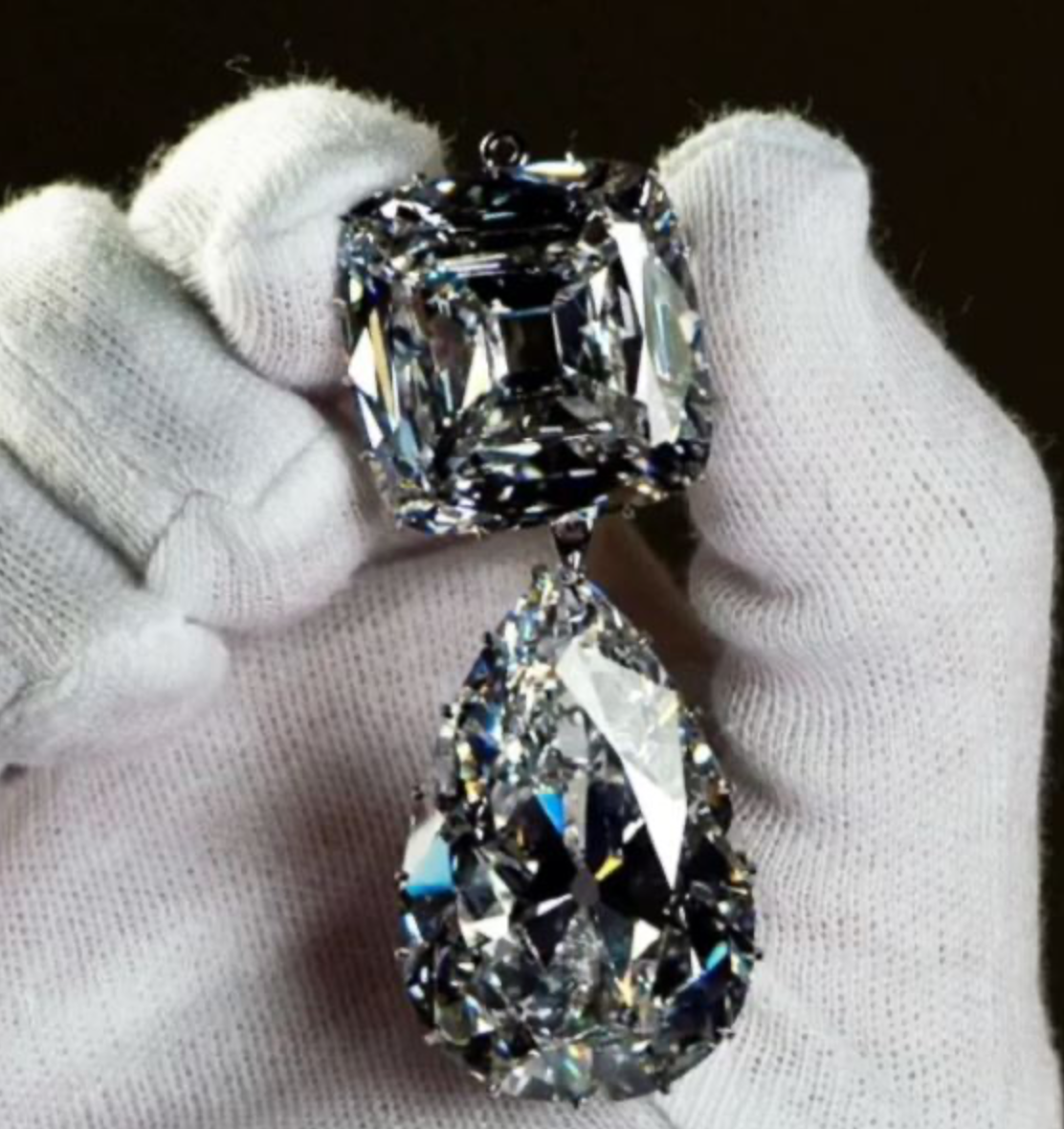
South of France 1990 © SJ Bennett
A short story by SJ Bennett …
The GREAT DIAMOND DECEPTION
August 2022, first published in Candis Magazine
The Earl of Landsdale is fictional, but the stories of the Cullinan’s travels depicted here are true
‘The person I feel sorry for,’ the Countess of Landsdale said, after a thoughtful sip of champagne, ‘is poor Mister Asscher.’
‘Well, if he will go into the diamond business, he must be prepared to suffer the consequences,’ her husband responded cheerfully.
George, the sixth earl of Landsdale was a popular but down-at-heel member of the set that had revolved around Bertie, Prince of Wales, when his mother Victoria was on the throne. Now, at the turn of the new century, good-time Bertie had become rather serious King Edward VII. Like his predecessor, King Henry V in Shakespeare’s play, which the earl somewhat vaguely remembered – he hadn’t been Eton’s finest scholar, thank goodness, because those young men had rightly their academic airs and graces knocked out of them at every opportunity – the new king had parted company with his most dissolute friends and started consorting with bishops and cabinet ministers. It would not do.
It was boring and ungrateful, the earl thought, and it had practical consequences. In the good old days, the mere mention of the Prince of Wales’s name was enough to placate the tailors, wine merchants, jewellers and all the other little men who provided life’s essentials. Now tradesmen had the temerity to ask for cash. The earl resented this enormously. He needed funds for the gaming tables, and for the rather glorious chorus girl – two chorus girls, in fact – whose accommodation in Covent Garden he very generously provided. He had a plan, however. It involved his erstwhile royal friend, and diamonds. One diamond in particular. And Mr Abraham Asscher who, as any sensible gentleman would agree, had brought this on himself.
‘The train for Harwich leaves tomorrow at six fifteen.’
‘I know,’ the countess said.
‘You must look your most charming. Wear purple, it suits you.’
‘My outfit’s already decided. I know how to look charming,’ his wife retorted.
‘Let’s practise one more time.’
The countess sighed. She stood up, fanned her lovely, fine-boned face and, in the middle of the drawing room of their Mayfair mansion, made a pantomime of pulling down a train window. She then turned pale – her ability to do this at will being one of the reasons her husband had chosen her for the task, and not one of his chorus girls – and fainted dead away on the drawing room carpet. Even the earl, who had seen this many times before, was impressed. His wife’s breathing was shallow and rapid. She seemed to hover between life and death. No gentleman worth his salt could fail to go to her aid, or even, as in this case, a tradesman such as Mr Asscher.
‘Excellent,’ Landsdale said. ‘You can get up now.’
She opened one eye. He offered her his hand to help her stand. Within a minute, the colour had returned to her cheeks and all was well.
Given the fine-tuning of the plan, ninety seconds was all it would take.
Two months earlier, the king had celebrated his sixty-sixth birthday at Sandringham. The royal party marked the occasion by shooting several hundred pheasant and partridge on the estate, followed by a lavish candlelit dinner attended by several dukes, three queens, and a surfeit of cabinet ministers.
The highlight had been the arrival of a purple velvet box on a silver platter, which was carried in by two footmen and set before the king. The Agent-General of the Transvaal said a few words: it was a gift from his government, after all. And then Edward opened the box to reveal a rough-edged, uncut diamond about the size of a swan’s egg, so clean and pure it looked as if it were made of glass.
Grinning, the king held it up to the assembled company, to a chorus of oohs and ahhs. This was the Cullinan – the biggest diamond ever found. Discovered two years ago, it had been formed in the earth’s core more than a billion years before. It was over three thousand carats in size, enough to make sparkling necklaces for every woman in the room, and worth two thirds of what the king had paid for the whole Sandringham estate. Queen Alexandra herself, whose swan-like neck was already roped in several strands of diamonds and pearls, couldn’t take her eyes of it.
The king already knew its story. Getting the diamond from South Africa to England had been an interesting affair. A team of detectives had been hired to guard it on its two-week passage from South Africa in a transatlantic steamer, to ward off the criminal gangs around the world who knew about the journey to London and longed to get their hands on it.
‘The lowlifes tried,’ the king recounted. ‘And the lowlifes failed.’ There were cheers around the table. ‘And even if they’d got the strong box from the captain’s safe, it wouldn’t have made any difference because …’ He paused for effect. ‘The real diamond – this one – was sent to London by regular post in a simple cardboard box!’
The company roared with laughter. Many had already heard the story, but they enjoyed hearing it again, especially from the king himself. It was quite true, and had already become part of the legend of the Cullinan. Edward then solemnly promised that the magnificent gift would become an heirloom of the Crown.
Not if I have anything to do with it, thought the earl. He knew diamond cutters with no principles – or at least, he knew men who knew them – who could turn the original rock into hundreds of decent brilliants that would keep the Landsdale family in funds for a couple of generations. True, they couldn’t risk making anything too large and showy, or people might get suspicious. Quantity, not quality, that must be the name of the game.
Meanwhile, possibly the greatest diamond cutter in Europe – Mr Abraham Asscher from Amsterdam – had been chosen by the king for the official job of creating the finest gemstones out of the Cullinan. Whatever was left, he could keep for himself as a reward. Asscher had had arrived in London a week ago to examine his prize and the newspapers announced that the rock would be transported to Holland on a Royal Navy frigate, to ensure its safety on this, its second dangerous journey.
But Landsdale knew better. He suspected a ruse. Nobody, the earl reasoned, would suspect the diamond of travelling in the same extraordinary way as last time. Cowed by the reputation and sheer might of the Royal Navy, all but the most foolhardy of criminals would admit defeat. And yet, the warship couldn’t sail all the way to Asscher’s workshop in Amsterdam. There would be transfers, weak links, moments of opportunity. Were the earl himself in charge of the operation, he would be audacious. He would indeed repeat the trick that had worked so well. But not with the mail this time – that would be asking for trouble. No, the earl reasoned, I would send it via Asscher himself. Who would suspect a sober Dutchman?
And if that was the case …
The next three days had been busy. Asscher’s distinctive leather attaché case had been ‘borrowed’ by a compliant servant while he slept, copied and recreated with every bump and stain and scratch of age, in a two-day marathon that had cost Landsdale a small fortune in itself. The most lightfingered thieves in London had been recruited. All that was needed was a suitable distraction. Enter the countess. The earl really was quite fond of his talented wife.
On the morning of 24 January 1908, the captain of the Royal Navy frigate at Southend took charge of a strong box bearing the king’s insignia, watched over by several officers from Scotland Yard.
Eight hours later, Mr Abraham Asscher went by hansom cab, alone, from his London lodgings to Liverpool Street station, where he boarded a first-class compartment on the six fifteen train to Harwich, from where a berth was booked on the overnight ferry to Rotterdam. He carried his familiar, battered leather attaché case and a Gladstone bag, both of which he installed in the luggage rack above his head.
As he was settling into his window seat, the door to the compartment opened and two people entered: an elderly, careworn cleric dressed in black, and his tweed-clad assistant, a meek young man in horn-rimmed spectacles. They nodded to the sturdy-looking Dutchman by the window, installed their own bags in the luggage rack, and took seats opposite each other near the door from the corridor. Not long before the train was due to start, a beautiful, fine-boned woman, her face half-hidden by a sable stole, joined them and took the window seat opposite Mr Asscher.
Instantly, the jeweller suspected something. He felt like a character in a play, surrounded by fellow players – but one who had not learned his part. With a snort of steam, the train set off. The game was afoot.
Abraham Asscher was a man used to taking risks. You had to be if your job was to cut the hardest substance on earth. One slight mistake and a perfect stone worth many thousands could be spoiled for eternity. Examining the Cullinan in London, he had already formed some ideas about where to and how to cleave it, but it would be weeks before he was absolutely sure. He hoped to get seven or eight magnificent, flawless diamonds from the rock, including at least two that would outrank any in existence. The king had talked of such stones finding their place in the Sovereign’s Sceptre and the Imperial State Crown. Henceforth, they would feature in every British coronation. But first the Cullinan had to reach Asscher’s workshop. Fully aware of what was at stake, he observed his fellow passengers with curiosity.
The cleric, tall and gaunt, took out a newspaper and sat ensconced behind it. His younger companion played nervously with the fingers of his gloves. Asscher felt fairly sure he had seen the woman facing him before. Her eyes and cheekbones were familiar from a picture in a society magazine, but the woman he remembered was dark-haired, whereas this one had tight-set auburn curls under her jaunty purple hat. Was it a wig, and if so, was it making her uncomfortable? Or was it her corset? Whatever it was, she seemed to become increasingly distressed.
When the train was a mere ten minutes from its destination, she fanned herself with one hand and got up to open the window. Asscher rose to help her, but as he did so she visibly paled and fainted dead away at his feet.
The other two leaped up. ‘Quick man, do something!’ the cleric shouted.
Asscher crouched down to feel for the woman’s pulse. As he did so, he was aware of movement behind him and glanced up to see the cleric removing his coat.
‘For a pillow,’ the man explained.
But Asscher’s own coat was thicker. He took it off, folded it and gently placed it under the lady’s head.
There was more movement above him. Now, the cleric was getting his bag down.
‘I think I have smelling salts. My housekeeper, you know … Oh goodness, where can they be? Hoskins, go and get the conductor, will you? Quick, man! Hurry!’
Asscher was no fool. As the door to the corridor closed behind the assistant, he glanced up again at the luggage rack, but both his bags still sat there in plain sight. The poor woman gave a soft groan meanwhile, and her eyelids fluttered. Then slowly her senses seemed to return. The cleric found his smelling salts and waved them under her nose.
The young man soon returned with the conductor. Asscher didn’t notice exactly how long he had been gone for, but it couldn’t have been longer than two minutes. He seemed somewhat agitated. The lady, feeling better, apologised profusely. By now, the train was pulling into its destination. Asscher retrieved his coat and brushed off any dirt from the carriage floor.
As they prepared to leave, the fainting beauty apologised once again and thanked Asscher for his kind concern.
‘No, I’m sorry for you,’ Asscher said. And he was. Between them, they had all put on such a performance.
He assumed they must have done a trick with a substitute attaché case. He hadn’t noticed a switch, but the cleric had probably pulled it from his own capacious bag while Asscher was putting his folded coat under the lady’s head. The original must have been smuggled out when ‘Hoskins’ went for the conductor, and switched back on his return. Two minutes is ample time to find a train official and, first, to search the case and find an empty box.
How disappointed they must be.
They would assume the diamond was on the frigate after all, the jeweller concluded wrily. All that wasted time and effort. If only they knew.
He patted the inner pocket of his trusty winter coat, where a rock the size of a swan’s egg nestled in a leather bag. Asscher was a man who was used to taking risks, but keeping the diamond close to his heart had always seemed the most sensible course, as today’s little adventure illustrated nicely.
The lady had been so close. Without realising, she had actually rested her beautiful head on top of it. The performance had been worthy of the West End stage.
The Countess of Landsdale! That’s who she reminded him of, despite the business with the auburn hair. Her husband was a well-known reprobate. He would be cursing himself tonight. But, as Mr Asscher boarded the steamer with the diamond still safe in his coat pocket, it was the countess that he felt sorry for.
THE END