Queen Elizabeth II: Her Life in Style
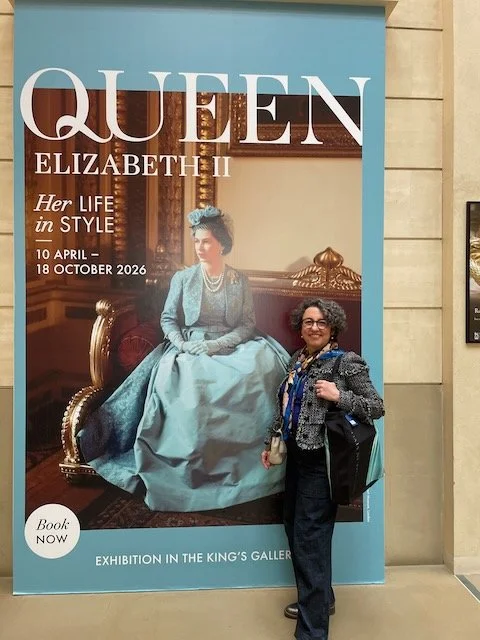
Tuesday, 21st April marks the centenary of the late Queen’s birth.
There are all sorts of books, TV programmes and articles to mark the occasion, but the one that I’ve most enjoyed is a new exhibition of her clothes at Buckingham Palace.
Of all the exhibitions about the Queen – regarding any aspect of her life – this is the one that was always going to resonate the most for me. I first encountered her through my fascination with her clothes as a child, and that’s what got me interested in her as a person: her life, her job, her taste, the complexity of being so much in the public eye, and how she used imagery more than words to let us know how she wanted to be understood. The thing is, I know these pieces intimately, and the exhibition needed to be fabulous to do them justice for me. And it was.
The exhibition, which opened last week, has been a smash hit from the start. The outfits are on display in the King’s Gallery, which used to be the Queen’s Gallery, built on the site of the chapel bombed by the Germans in the Blitz. Usually, large fashion exhibitions take place at the Victoria and Albert Museum, and this one has a similar feel.
Curators are saying that lots of visitors are finding the displays surprisingly emotional. I was one of the first people through the door (I booked months ago), and I completely agree. As a fashion exhibition, it’s fantastic, up there with the best, but as a window back into recent history, it’s something special. These are the dresses, coats and hats that we saw an icon wear in big moments throughout our lives, but usually far away, on a TV screen, or captured in a photograph. Now we can see them up close and get a real insight into the woman who chose them, wore them and – amazing when you see those tiny waists for the first third of her life – actually fitted into them.
We see what Elizabeth wore growing up, and then at work, at home and at play. In the process, we get to know her better. Plus, because she had access to the best couture designers and embroiderers, we see some of the finest fashion craftsmanship a woman has ever worn. That’s part of the emotion. On top of that, the sheer number of outfits, the space they’re given in the galleries, the beauty of the displays, the clever lighting, means that it’s almost overwhelming to be in the space with them. I was so impressed that I’ve already booked my ticket to go back.
I realise that of course lots of you who might want to visit won’t be able to go - or perhaps you’re reading this when the exhibition’s already over. There’s a beautiful book to go with it (a large, heavy hardback which I ended up taking round the gallery with me!), which is available from the Royal Collection Trust here. Royal Collection Trust here
There are literally hundreds of outfits on display, all beautifully preserved. A curator told me that they are generally stored in large, flat boxes in Windsor, which has kept them in good condition. A huge amount of work has gone into refurbishing those pieces that needed it. Most look as if Elizabeth has just finished wearing them.
I can’t talk about all the outfits, much as I’d like to. But I can highlight a few. Here are the ones that made the biggest impression on me.
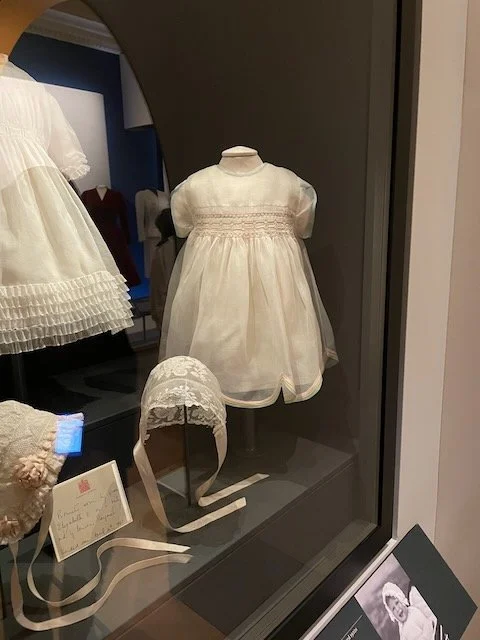
The smocked dress she wore as a toddler. What shocked me here was that I had several like it, made to the same standard and smocked with the same skill and care, by my grandmother, Jessie Pett, who did piecework for a dress company when her children were young, and carried on when I, her first grandchild, was born. I took it for granted that little girls had dresses made like this. Didn’t everyone? It turned out that what Granny made for me was quite literally fit for a Queen. I’d have kept all mine with great reverence if I’d realised. However, I always knew Granny was an incredible craftswoman. She was a great cook, too, a generous hostess, and wonderful company.
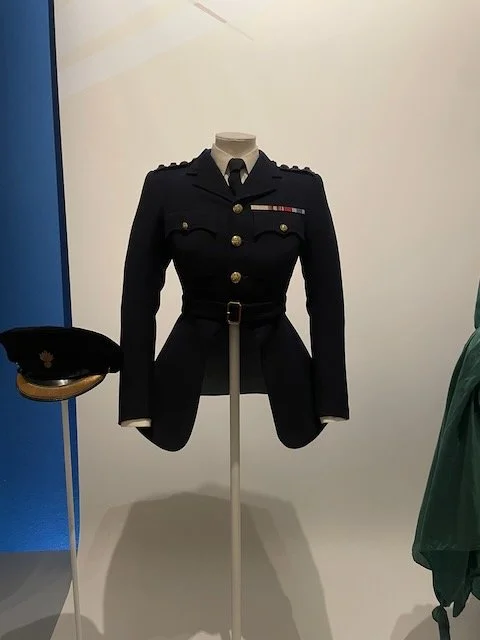
Uniform and evening dresses worn as a princess. Another surprise was just how small the Queen’s waist was, until she was well into her thirties, having had two children. I knew Princess Margaret’s waist was tiny, because it’s highlighted by her Dior ballgowns, but I always thought the Queen had a more normal shape. No! Hers was tiny, too. To think of so much indomitability and strength, packaged in such a small frame, is really quite something. We naturally seem to admire tall, broad humans as our leaders, but these clothes show that we might be seriously missing something when we do. Speaking as another short woman, I find it both encouraging (see what we can do!) and disappointing (but so many don’t see).
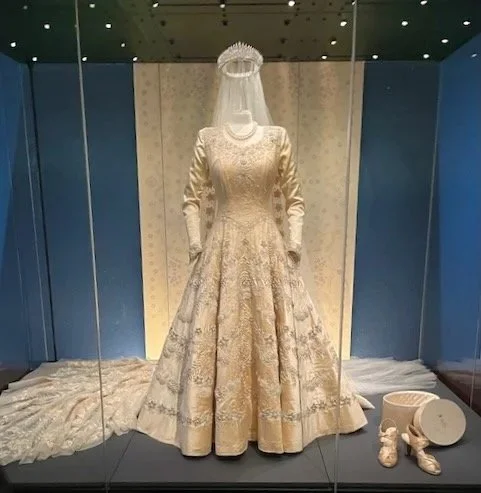
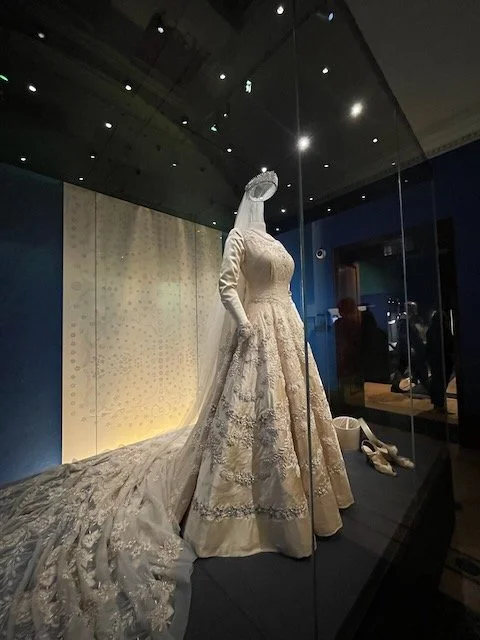
The wedding dress. Lots of us know the story of this dress, made for Princess Elizabeth in 1947, when the country was still suffering the after-effects of the war, and rationing was still in place. Many women offered to share their clothing rations to enable her to have the silk she needed. Norman Hartnell’s career as a couturier was further cemented by making the iconic dress for her, and there’s a great article about it here.
The flower-filled design was inspired Botticelli’s Primavera. Unfortunately for posterity, the silk was treated with tin salts at the time to improve the weight and drape of the fabric, which has resulted in it becoming extra brittle and fragile. Despite the best attentions of the conservation team, the seams on the bodice are only just holding it together, which somehow gives it extra poignancy.
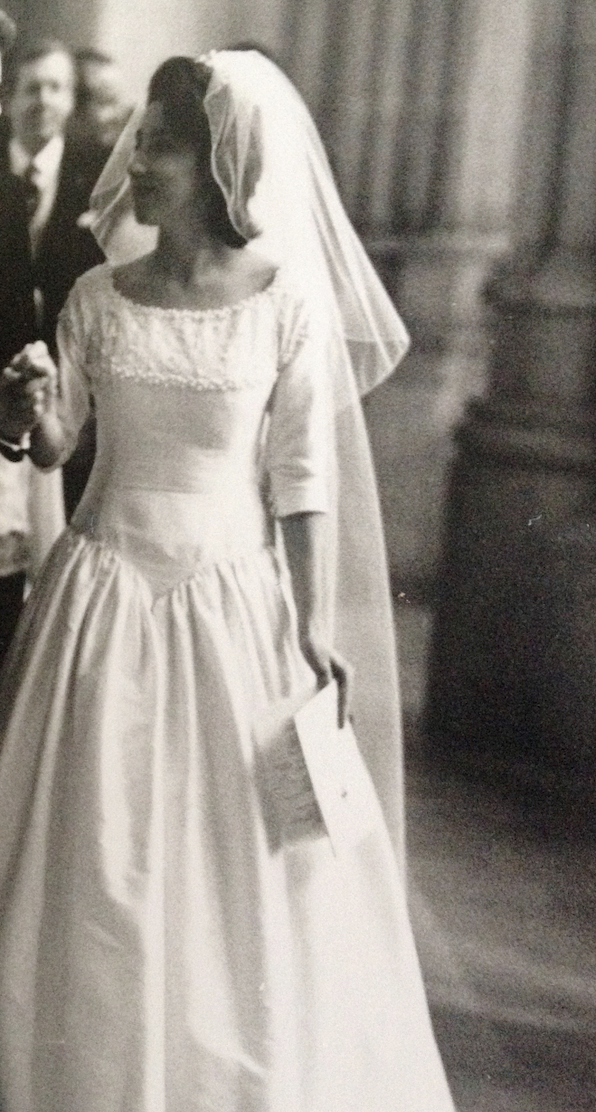
What surprised me here, as someone who’s known this dress since I was eleven and started paying attention, is how much it reminded me of my own first wedding dress. There’s a picture here. Mine was a second-hand Catherine Walker dress. See what you think.
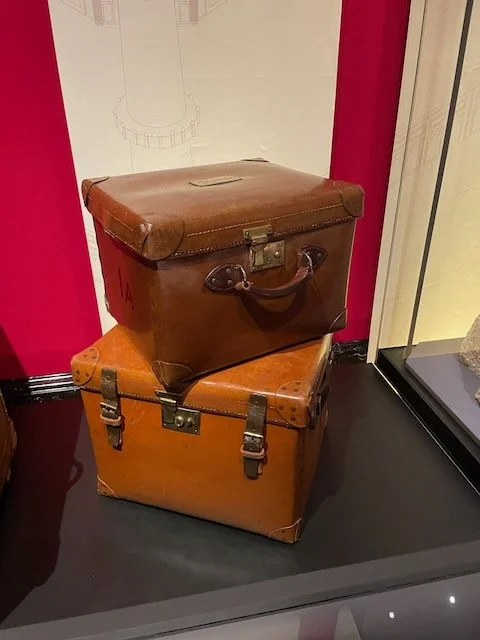
Accessories. The exhibition also includes some of the trunks and vanity cases the Queen took with her on her many travels. They were well-made and sturdy, and she used them for dhttps://www.countryandtownhouse.com/style/fashion/queen-elizabeth-ii-wedding-dress/ecades. It’s tempting to imagine the life they must have had, following her around on planes, trains and the royal yacht, literally circling the globe.
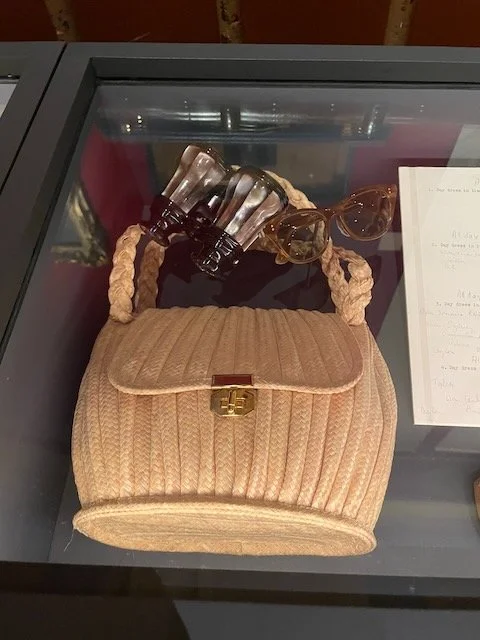
There’s a cabinet containing a handbag and some binoculars that she had with her on her trip to the Caribbean in 1966. This is the tour that forms the background to Death on the Royal Yacht, which I’ve just finished proofreading before it’s launched later this year. The five-week visit has been vivid in my imagination for the last several months, so to see artefacts from it was rather strange: fact and fiction converging.
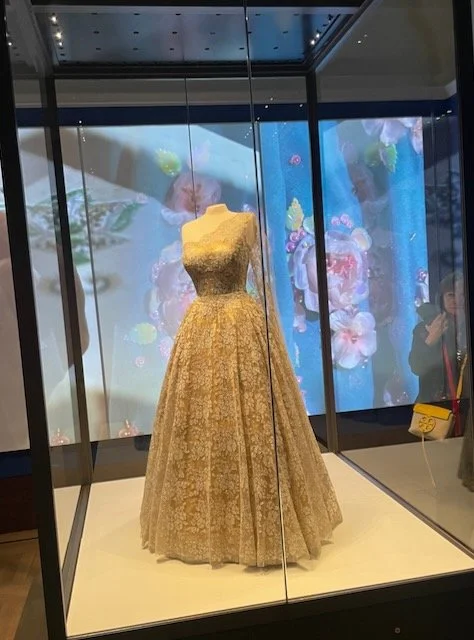
The ‘main event’ of the exhibition is really the large collection of embroidered and sequinned evening dresses the Queen wore on her state visits, in her role as an ambassador for the UK. They are exquisitely made, beautifully presented, and alive with fascinating details. She rarely missed the chance to show respect for a country she was visiting by adopting its national colours, or having its national flower embroidered into her clothes. Her dresses manage to be sexy, but modest (until she was into her sixties, anyway), to stand out in a crowd without being ‘flashy’, and to showcase clever designs and cutting, while taking advantage of new textiles and techniques. I love the back of the silver and gold sequinned dress she wore to Rome in 1961 (see The Queen Who Came In From the Cold), and the green and white dress she wore to Pakistan that same year, with a bold and graphic curving train.
The images below are a carousel, so if you click/scroll across, you should see more of them.
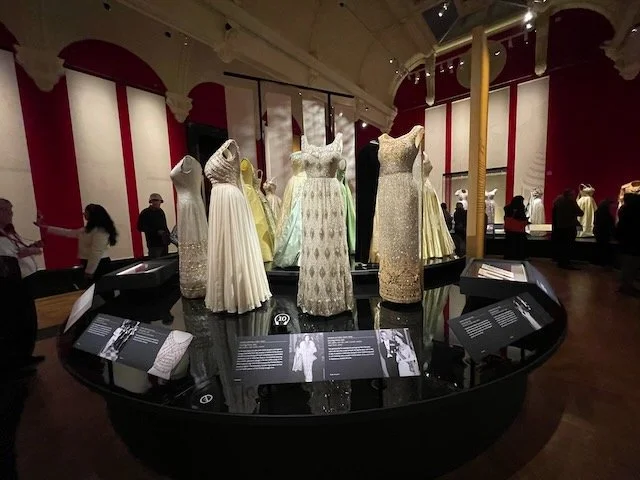
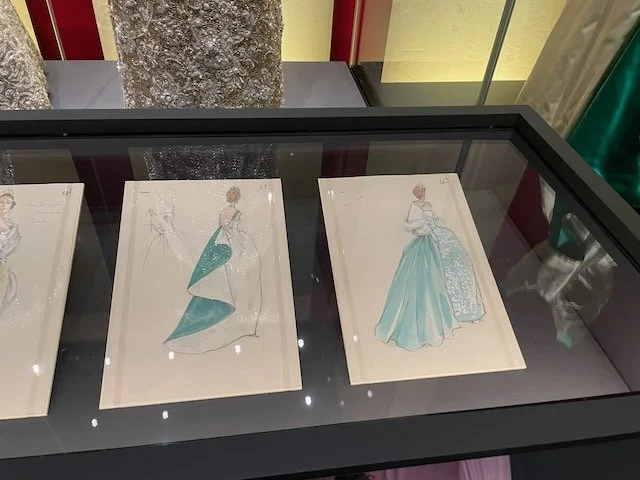
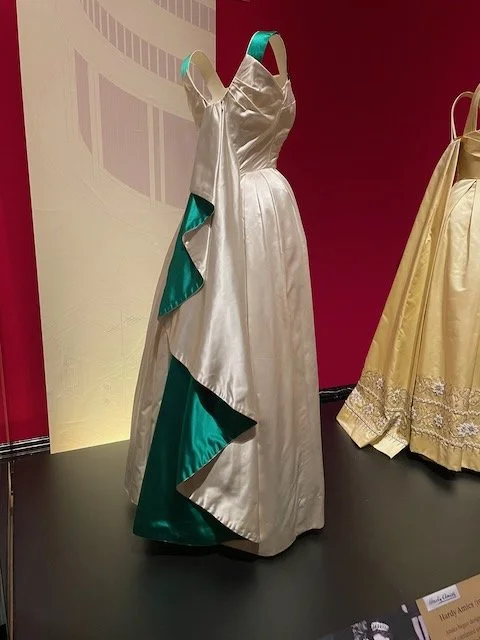
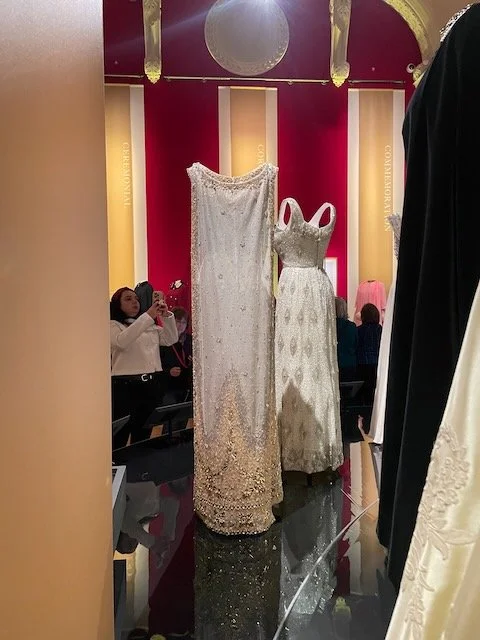
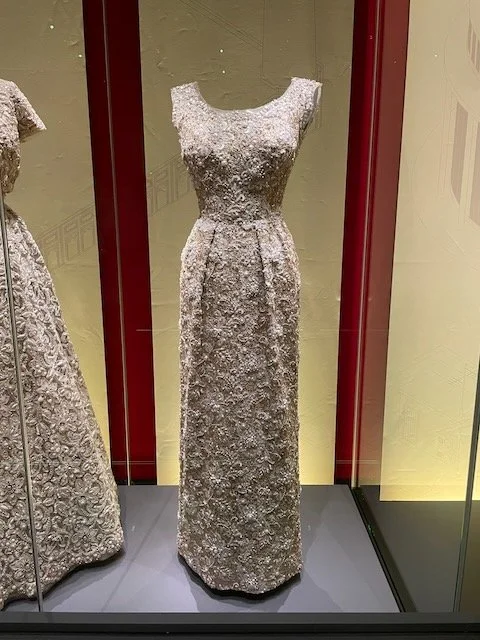
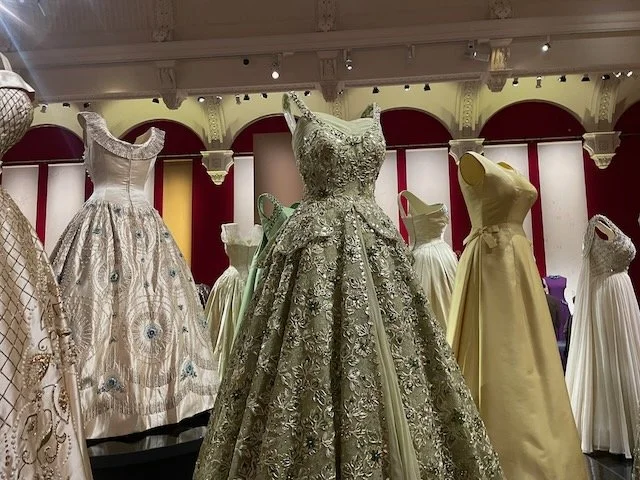
It was the detail and the thoughtfulness that went into these state visits that first drew me to the Queen when I was eleven. I wasn’t particularly interested in the head of state, but I was very interested in fashion and psychology, and when I realised how difficult it was to dress in a way that stood out, but wasn’t a slave to the latest trends, to look relaxed while making sure your skirts never blew up in the breeze (curtain weights were used), to be instantly recognisable in a crowd, in an outfit that was very hard to replicate … All these obstacles and contradictions made me want to know more about the Queen.
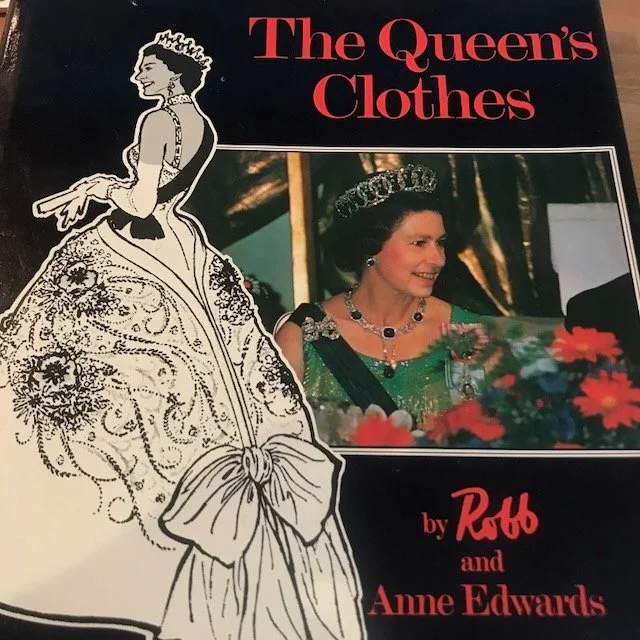
The details were explained in a book called The Queen’s Clothes, which I was given in 1977, and still have on my bookshelf. It included some of Norman Hartnell’s sketches for the Queen, like the ones also included in the exhibition, which are lovely to see, alongside the finished gown.
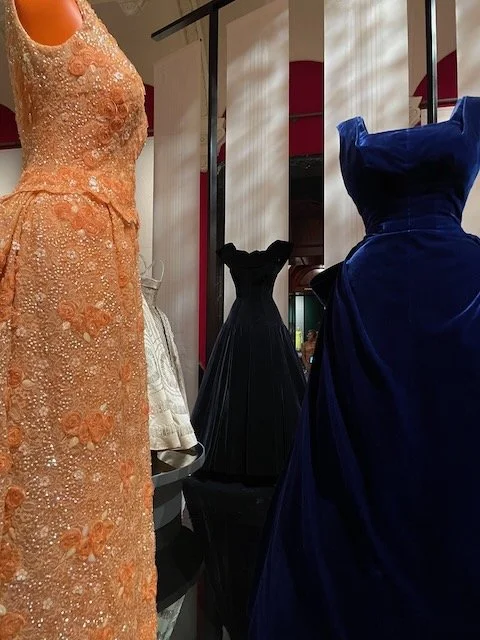
The black velvet dress the Queen wore to meet Marilyn Monroe in 1956. It’s at the back of a trio of dresses in the exhibition, so it was hard to get a good picture, but it’s always been iconic for me. Off the shoulder, in a very simple design with a large crinoline skirt, it relied on the Queen’s very good skin to provide luminescence and contrast. At the Royal Palladium, Marilyn wore a figure-hugging gold lame dress that made her look like a blonde Greek goddess.
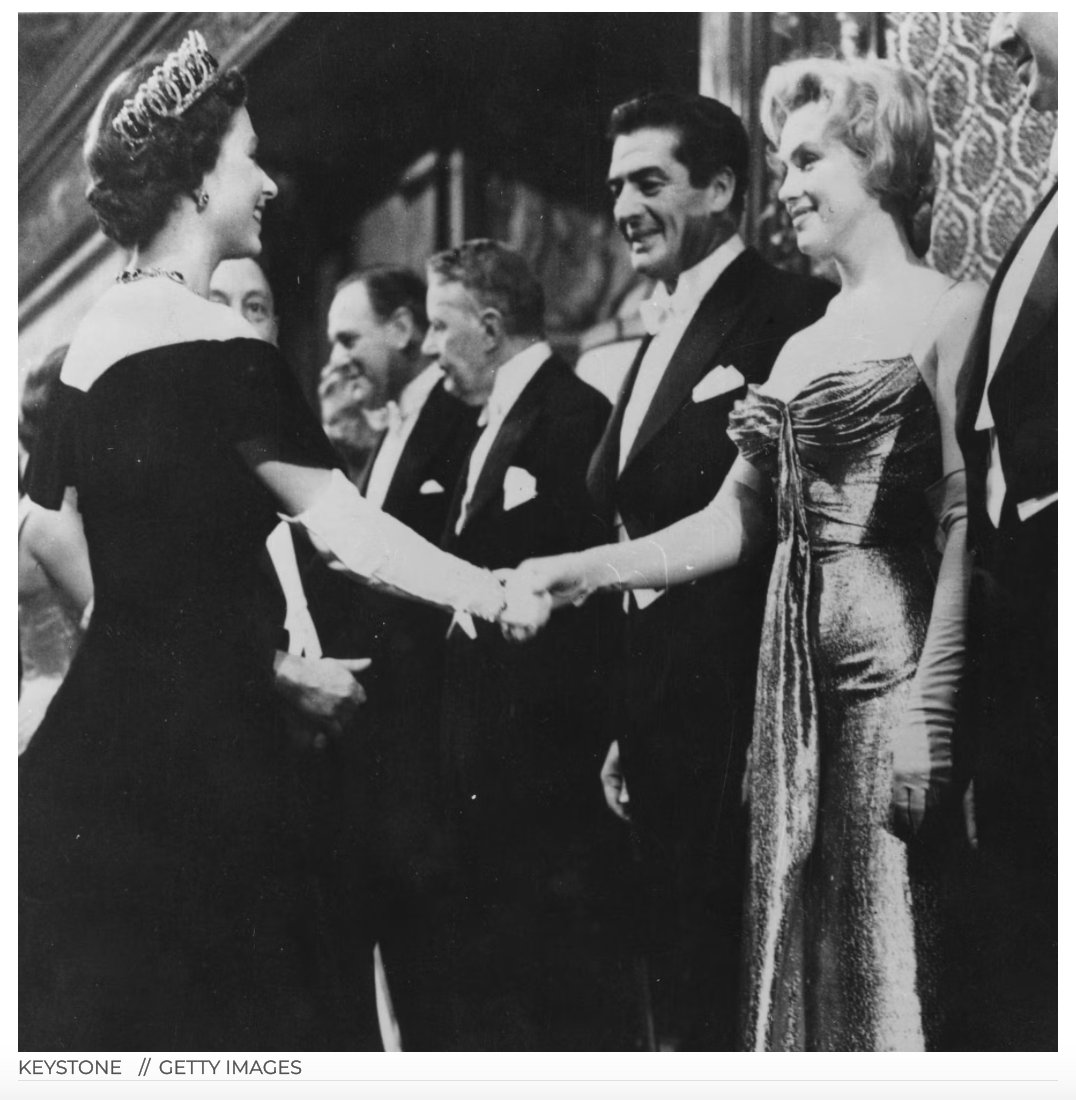
I love the picture of these two women of almost the same age – in their mid-thirties – meeting each other for the only time. Of the two, it’s the Queen who looks more confident. Marilyn apparently chewed off all her lipstick with nerves beforehand, not that she needed to worry. She was living on the Windsor estate at the time while she filmed The Prince and the Showgirl with Lawrence Olivier, and hoped to meet Elizabeth again, but they were both too busy for that to happen. What a shame. If they’d had the chance, they’d have had so much shared experience of being looked at and objectified to talk about. As it is, that one brief meeting gets a mention in A Death in Diamonds, set the following year.
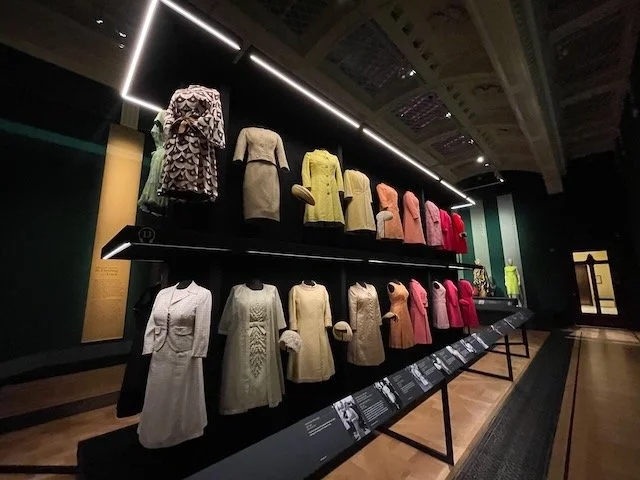
One room in the King’s Gallery is devoted to a series of dresses and coats from across the decades, highlighting the Queen’s rainbow choice of single-colour outfits. So much to look at … Here’s a picture. There’s also a great display of her hats.
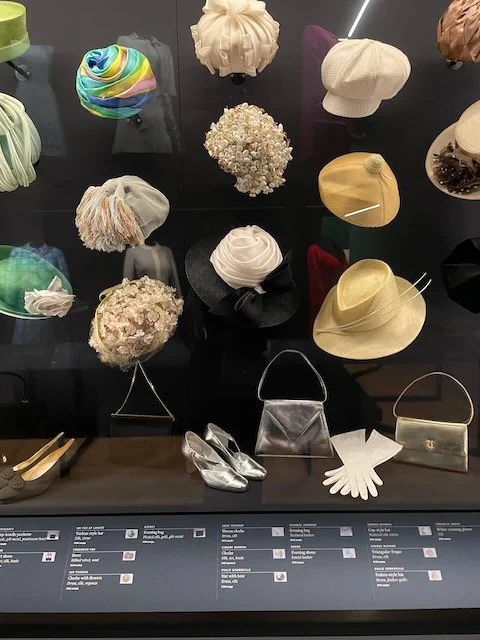
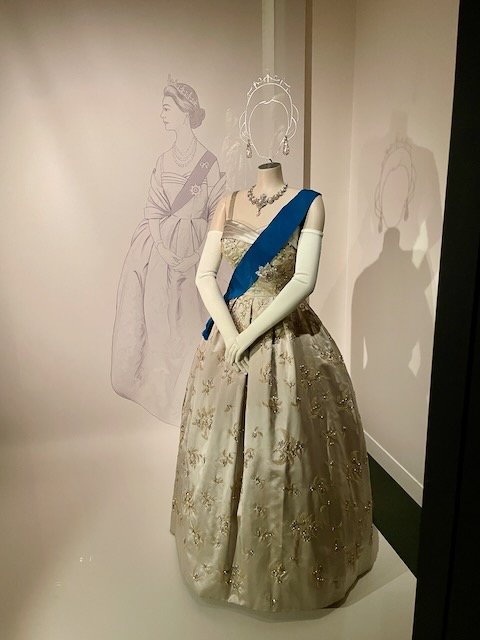
Something rare and unique about the exhibition is that where appropriate, it includes the pearl and diamond necklaces, earrings and tiara that the Queen wore with a particular dress. It’s amazing to see these priceless jewels alongside the clothes. I’ve often heard about the effect of meeting her when she was dressed in all her sparkles, but I didn’t think I’d get to see it for myself. Many women get to wear the same quality of couture in their lives, but very few have, or had, access to the same accessories.
It’s lovely to see the peach silk dress designed by Angela Kelly that she wore to meet James Bond and travel to the opening ceremony of the 2012 Olympics. We all remember it so vividly from that day, and it’s fun to see the stunt double outfit that was made to go with it. (I wonder how many people still believe she jumped out of a helicopter above the stadium on the night.)
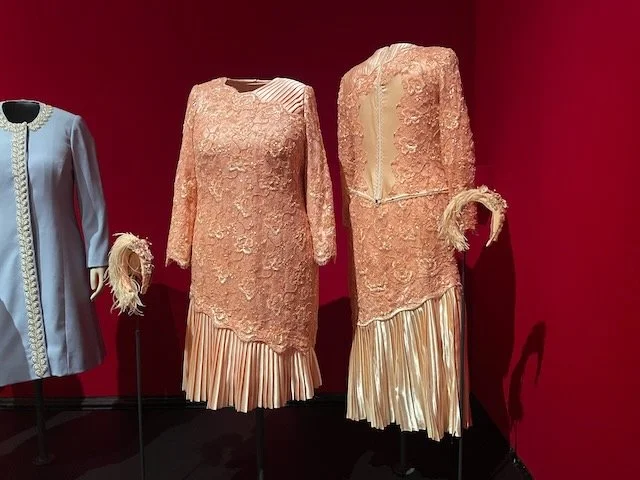
In her later years, the Queen was prepared to be more playful with her image. I think she must have realised she wasn’t going to damage it by then, and Angela Kelly shared her sense of humour, and was more than happy to go along with it. For that meeting with Mr Bond, a wig was carefully made for another stunt double, to show the back of the Queen’s head as she sat at a writing table. But it wasn’t needed, as she performed that part herself. In fact, she insisted on it!
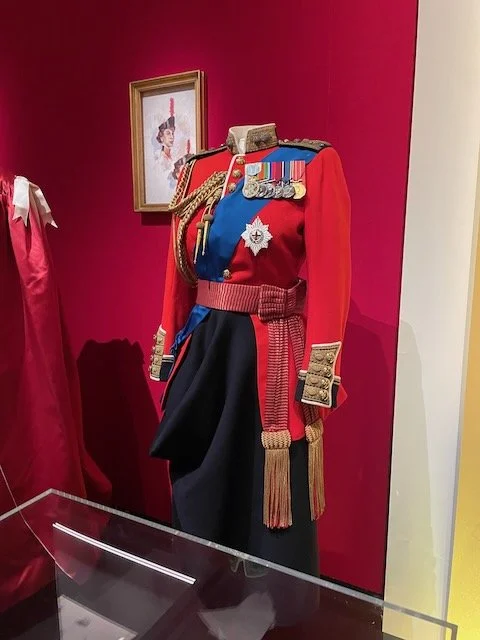
The image that stays with me the most is the red tunic of the Grenadier Guards that the Queen wore for Trooping the Colour. Elizabeth looked good in a uniform, all her life. Which is lucky, because she wore a lot of them. She wore this one to ride her favourite horse, Burmese, in dozens of iconic photographs. This was the Queen I first really admired: dignified, sporty (imagine what it takes to command a horse like that, sidesaddle, past the crowds on the Mall, including being shot at by a bystander and carrying on as if nothing had happened), horse-loving, capable, incredibly smart. Positively iconic. Just as I try and recreate her in my books.